
When Rob bought 14 acres near Ada in 2020, he didn’t plan to overhaul a neighborhood’s approach to deer management. But a letter‑writing campaign, a backyard meeting over dinner, and a growing obsession with data turned a loose group text into one of West Michigan’s most intentional, metrics‑minded deer cooperatives.
“We’re at a point where the co‑op has unbelievably high engagement and intense, data‑driven management.” — Rob
What started at roughly 200 acres in 2021 quickly doubled, then doubled again, and — after aligning goals and data‑sharing with neighboring properties — now influences 2,500 contiguous acres.
From Backyard Meeting to 2,500 Acres
Rob’s first step was simple: identify neighboring hunters, send personal letters, then hosted a dinner gathering.
- 2021 — Kickoff at Rob’s home; ~11 attendees; informal texting; ~200 acres represented.
- 2022 — Word spreads; ~500 acres; basic harvest data tracking.
- 2023 — ~800 acres; deeper data (buck scoring, tooth aging); recognition of high deer density.
- 2024 — Collaboration expands. Rob, the nearby Grand River cooperative, and ~1,000 acres of adjacent privately managed lands align goals and share data, effectively coordinating ~2,500 acres.
The cooperative tightened its feedback loop: measure more, communicate faster, and adjust policy together. A five‑member leadership team formed — selected for engagement and complementary strengths (including a member who documents the local herd with exhaustive photo intel).
EHD Shock, Then a Reset
The cooperative’s biggest test came when EHD hit. Members stopped shooting and switched to documentation.
- Carcass survey: The group logged sex, approximate age, and locations of mortalities and estimated 112 deer per square mile found dead.
- Pre‑EHD density: Based on observations and discoveries, the cooperative believes the landscape had swelled to ~150 deer/mi² — far too high.
- Post‑EHD thermal survey: The winter following the die‑off showed ~12 deer/mi² — effectively a reset.
“Desolate. Trail cams would ping maybe once a week. I didn’t sit in a stand that fall,” Rob recalls.
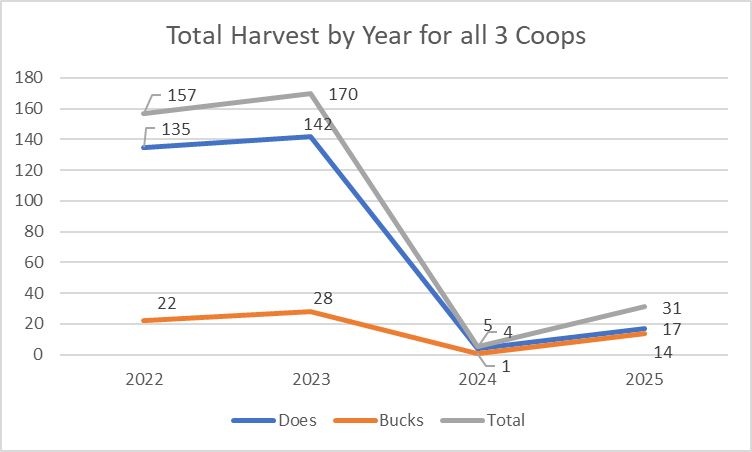
By the next winter, the landscape recovered to ~45 deer/mi² (31 deer harvested across 2,500 acres: 17 does, 14 bucks). The difference was stark: at lower densities, deer stacked onto the best habitat, moving predictably with forage and cover; at 100–150 deer/mi², habitat quality mattered far less because deer were everywhere.
A Surprising Ratio Flip — and a Management Puzzle
Post‑EHD, the cooperative observed a temporary buck‑heavy skew — Rob estimates 1.5 to 2 bucks per doe — likely driven by yearling male dispersal into newly “vacant” habitat. That raised a strategic dilemma: how to hold densities in a healthy range without over‑skewing sex ratios, and what to shoot when “just take does” isn’t feasible everywhere, every year.
The cooperative has experimented carefully with selective buck harvest (e.g., targeting mature 6‑points), recognizing both the biological nuance and the social sensitivities when aging deer in the field — and especially as one‑buck proposals are discussed at the state level.
“We’re trying to balance hunter satisfaction and herd health. Short‑term, fewer deer can feel tough. Long‑term, it’s the only way you get bigger, healthier deer.”
Metrics, not Myths: How the Cooperative Manages
- Thermal‑drone surveys (February) to estimate winter density
- Tooth aging and buck measurements for structure and quality trends
- Harvest logs (sex, weights when possible) and centralized reporting
- Collaborative food strategy with a neighboring property leaving 30 acres of corn/beans standing through winter
- Predator trapping (three years of “nest predator” data) with a notable turkey rebound
- Annual kickoff with a slide deck of identifiable bucks (by name) to align expectations and improve voluntary passing of “medium” deer
Participation stays high: roughly 75% attend the August kickoff, while a handful of highly engaged members contribute the bulk of harvest effort and data. A robust text chain keeps members sharing trail‑camera intel, tracking lost deer, and coordinating on harvest and trapping.
What’s Next: Browse Surveys, Smarter Doe Plans, and Donation Logistics
To ground density decisions in habitat reality, the cooperative may add browse‑impact transects this spring (before leaf‑out), establishing a nutritional baseline they can track every 1–2 years. The method is simple enough to be a family workday and will clarify how much winter browse the habitat can support.
(View a video on how and why to do this here.)
On harvest planning, the group is thiking about a cap with aggressive targets (rather than “open season”) to sustain credibility and trust while keeping densities in the management window. And because harvest hinges on processing capacity, the cooperative is exploring donation partners (veterans groups, regional venison charities, and reefer‑trailer options) to unlock early‑season doe harvest when temperatures are warm.
Community First, and the Results Follow
Beyond numbers, Rob credits relationships for the cooperative’s staying power. A core leadership team, transparent data, and constant communication have built buy‑in that makes tough pivots possible.
“If everybody knows what’s truly out there, they’re far more willing to pass smaller deer. Information builds patience — and patience builds a better herd.”
By the Numbers (Self‑Reported)
- Kickoff meeting (2021): 11 attendees; ~200 acres
- Growth: ~500 acres (2022) → ~800 acres (2023) → coordinated ~2,500 acres (2024–present)
- EHD carcass survey: ~112 deer/mi² found dead; mortality evenly split between sexes
- Density estimates: ~150→12→45 deer/mi² (pre‑EHD → post‑EHD winter → following winter)
- Recent harvest (2,500 acres): 31 deer (17 does, 14 bucks)
- Meeting turnout: ~75% of members
- Winter food: ~30 acres of standing corn/beans on adjacent, aligned property
Editor’s note: All figures are based on the cooperative’s internal logs, surveys, and observations.
Leave a Reply